Kingflex
Choosing the right Insulation Tube Foam is rarely as simple as comparing prices online. Global buyers must examine material quality, thermal performance, sizing accuracy, moisture resistance, and supplier reliability. A tube that works well in a dry warehouse may fail in a humid coastal project. Small details matter, especially around pipe joints, valves, and bends.
This guide shares ten practical buying tips based on common sourcing needs and real project conditions. It explains how to check foam density, wall thickness, temperature range, fire behavior, surface finish, and packaging quality. Buyers should also review samples before placing large orders. A crushed tube in a sample carton may reveal weak packaging or poor handling controls. That detail should not be ignored.
Clear specifications reduce expensive misunderstandings. State the pipe diameter, insulation thickness, required length, application temperature, and installation environment. Ask suppliers for test reports, product data sheets, factory photographs, and production samples. However, documents alone cannot prove consistent performance. Independent testing may be worthwhile for demanding applications. No buying method is perfect. Measurements can be wrong, communication can fail, and an attractive quotation can hide long-term costs. A careful buyer keeps written records and checks every critical claim. These habits support safer decisions, steadier supply, and more dependable insulation results across different markets.
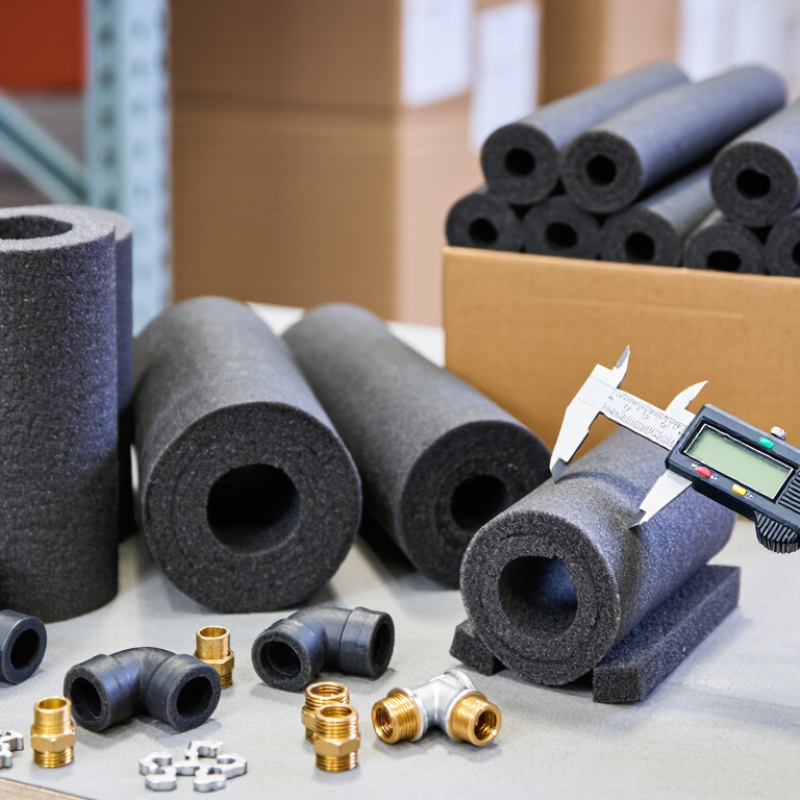
Global buyers should define the foam before comparing prices. Insulation tubes may use polyethylene (PE), elastomeric rubber, polyurethane (PU), or phenolic foam. These materials differ in flexibility, moisture resistance, fire behavior, and service temperature. Do not treat the label “foam” as a performance grade. At a declared thermal conductivity of 0.034–0.040 W/m·K, lower values indicate better heat resistance. However, the test temperature matters. Ask for the standard, density, thickness, and aging condition behind the figure. An unaged result can look excellent. Real installations face seams, compression, dust, and humid air. Those details can increase heat flow.
Compare equal thicknesses and equal test conditions. A 0.034 W/m·K claim is not automatically better than 0.040 W/m·K in service. A thicker tube with stable moisture performance may protect a pipe better. Check inner diameter tolerance, wall thickness, surface finish, and joint closure. For chilled-water lines, inspect vapor resistance and sealed seams. For hot lines, verify continuous temperature limits and dimensional stability. Also confirm applicable regional fire and chemical requirements. Request test reports, batch data, and a sample cut across the wall. Measure fit on an actual pipe. One practical mistake is trusting a certificate without checking production consistency. Another is ignoring installation skill. Even excellent foam fails when gaps remain at elbows or supports. Leave room for that human factor in your buying decision.
Wall thickness should follow measured performance, not a familiar catalog size. ASTM C534 evaluates flexible cellular insulation, including thermal conductivity, water vapor resistance, and surface-burning behavior. EN 14313 applies to factory-made polyethylene foam products and their declared technical performance.
Measure the pipe outside diameter first. Then record fluid temperature, ambient humidity, operating hours, and surface temperature limits. A thicker tube may reduce heat gain, but it can create installation problems around valves and tight bends. Condensation control often becomes the real priority in humid rooms. Do not guess here.
Ask for test reports from a competent laboratory. Check the declared thermal conductivity at temperatures close to your project conditions. A value measured at 10°C may not represent performance beside a hot process line. Confirm water vapor resistance, dimensional tolerances, and reaction-to-fire data. These details matter during approval and inspection.
Use a calibrated caliper on incoming samples. Small diameter errors can leave gaps along pipe joints. Inspect cuts, compression recovery, and adhesive compatibility. Keep batch numbers with purchase records. This supports traceability when results differ later.
One caution remains. ASTM C534 and EN 14313 do not create one universal thickness table. Climate, pipe temperature, moisture exposure, and local energy rules change the selection. I have seen buyers choose thick foam, then discover crushed sections at supports. The specification looked strong, but the installation method was weak. Review the standard edition and product scope before placing a global order.
For global buyers, PE foam tube selection should begin with operating temperature. Common grades are rated from −40°C to 95°C, but the rating is not universal. Density, wall thickness, moisture, compression, and exposure time can change performance. At 95°C, some tubes may soften, shrink, or lose adhesive strength. At −40°C, repeated movement can expose weak seams. Small details matter.
The U.S. Department of Energy’s Industrial Decarbonization Roadmap reports that process heating uses about 51% of manufacturing energy. Effective pipe insulation can reduce unwanted heat transfer around hot and chilled lines. The ASHRAE Handbook also advises checking condensation, surface temperature, and heat-flow calculations instead of trusting a catalog range alone. These references support a practical buying approach.
Tip: Request test data for the exact foam grade, not a generic PE certificate. Check thermal conductivity at your working temperature. Ask whether the 95°C limit applies continuously or only briefly. Review aging results, flame behavior, and dimensional stability. I would also test a short sample on the actual pipe. Laboratory ratings can look perfect, yet installation gaps, sunlight, and repeated expansion may change the result. Do not ignore that risk.
When buying insulation tube foam globally, verify the fire rating before comparing price or density. EN 13501-1 classifies reaction to fire from A1 to F. It also reports smoke production, from s1 to s3, and flaming droplets, from d0 to d2. These details matter in enclosed service shafts and crowded mechanical rooms.
ASTM E84 uses a different approach. It measures flame spread and smoke-developed indexes on a test surface. Class A generally means a flame spread index of 25 or less, with stricter performance expectations than Classes B or C. However, an ASTM E84 Class A result is not automatically equivalent to an EN 13501-1 classification. Treat them as separate systems.
Request the complete test report, not only a sales-page certificate. Check the foam type, wall thickness, surface finish, test orientation, substrate, and production date. A tube tested alone may perform differently when installed around metal pipe, adhesive, or fittings. Ask whether the report covers the exact size you will purchase. This step is often missed. Verify the laboratory’s accreditation and confirm that the report number matches the product documentation. A certificate can look convincing and still answer the wrong question. I would also keep samples from each shipment, because color, density, and skin thickness can change between batches. Standards guide a decision, but installation conditions still deserve careful review.
10 Insulation Tube Foam Buying Tips for Global Buyers
Audit a supplier before comparing prices. In practical sourcing work, MOQ often hides the real cost. Ask whether it applies per diameter, material grade, color, or shipment. A low MOQ may still require expensive tooling or mixed cartons. Request a written quotation with packaging details, lead time, and replacement terms.
Incoterms must match your logistics capability. Confirm who pays freight, insurance, export clearance, and destination charges. Do not accept a shortened trade term without understanding the risk transfer point. Check the commercial invoice against the agreed term. Small wording errors can create costly delays.
Review certification scope, not just certificate images. Verify the issuing laboratory, validity period, tested material, and applicable market. Ask for traceable reports covering thermal conductivity, density, compression recovery, dimensional stability, and flame performance when relevant. Requirements differ by application and destination. A certificate may not cover every tube size.
Test samples under realistic conditions. Bend them around the intended pipe, expose them to expected temperatures, and measure recovery after compression. Compare sample results with production records. I have seen samples pass while mass production varied slightly. That weakness deserves attention. Request a pre-shipment inspection, batch identification, and retained samples. Keep written records of every approval and change.
| No. | Buying Tip | Audit Dimension | Recommended Requirement or Benchmark | Documents, Questions, and Sample Tests | Common Red Flag |
|---|---|---|---|---|---|
| 1 | Define the application before comparing prices | Material and use case | Specify whether the tube is intended for HVAC, chilled-water piping, hot-water piping, plumbing, automotive use, or general mechanical protection. Select the material according to temperature, moisture, UV exposure, flexibility, and fire-performance needs. | Request a technical datasheet stating material type, operating-temperature range, density or hardness where relevant, water-vapor resistance, and recommended applications. Confirm the product is suitable for the actual pipe medium and environment. | The supplier offers one generic foam grade for all temperatures and applications without limitations. |
| 2 | Compare thermal performance on the same basis | Thermal conductivity and thickness | Compare thermal conductivity at the same mean temperature, test method, thickness, and unit. Do not compare a nominal value at 10°C with another value at 24°C. Verify that wall thickness and internal diameter match the design. | Request test reports showing thermal conductivity, test temperature, specimen thickness, test standard, and measurement uncertainty. Check a sample with a calibrated wall-thickness gauge and internal-diameter gauge. | A very low conductivity value is quoted without test temperature, method, or sample thickness. |
| 3 | Control MOQ and size-mix flexibility | MOQ, pack quantity, and SKU planning | Use the supplier’s written MOQ by size, material, color, and packaging format. As an RFQ benchmark, request a pilot order of approximately 500–2,000 linear meters or the supplier’s standard carton quantity, then negotiate mixed-size loading for repeat orders. | Ask for a formal MOQ matrix, carton quantity, pallet quantity, production lead time, and the price effect of smaller lots. Confirm whether different diameters can be combined in one production run or shipment. | MOQ changes after tooling, artwork, or payment, or the supplier refuses to provide carton and pallet quantities. |
| 4 | Select the correct Incoterm and landed-cost model | Incoterms 2020 and logistics | Request comparable quotations under FCA, FOB, CIF, or DAP where practical. Record the named place or port, export-clearance responsibility, freight assumptions, insurance responsibility, and destination charges. Use the current Incoterms® 2020 rules in the purchase contract. | Ask for carton dimensions, gross weight, loading quantity, HS-code proposal, production location, and freight-validity period. Calculate product cost plus origin charges, freight, insurance, duty, taxes, broker fees, and inland delivery. | The quotation states only “shipping included” without a named place, port, or allocation of customs responsibilities. |
| 5 | Verify dimensional tolerances and fit | Internal diameter, wall thickness, length, and slit | Define acceptable tolerances for internal diameter, wall thickness, length, straightness, slit alignment, and surface condition. The tube must fit the specified pipe without excessive compression, gaps, or installation damage. | Create an approved sample with a dimension drawing. Measure at least 10 pieces from different cartons using calibrated tools. Record minimum, maximum, and average values rather than relying only on one sample. | Dimensions are described as “standard size” with no numerical tolerance or inspection method. |
| 6 | Audit fire-performance claims separately | Fire classification and smoke behavior | Specify the required market standard and end-use classification. Depending on the destination and application, this may include reaction-to-fire classification under EN 13501-1 or surface-burning tests such as ASTM E84. A test result is not automatically valid for every thickness, color, facing, or assembly. | Request a complete report identifying the exact product construction, thickness, density, color, test laboratory, test date, and scope. Check whether the report covers the supplied formulation and intended installation. | “Fireproof” is used as a marketing term without a traceable report or without stating the tested thickness and product structure. |
| 7 | Check chemical and regulatory documentation | REACH, RoHS, VOC, and market access | Identify the destination-market requirements before ordering. For EU-related supply chains, request a current REACH declaration and SVHC communication where applicable. For products used in electrical or electronic equipment, assess whether RoHS applies. Ask for VOC or odor information when indoor-air requirements are relevant. | Request signed declarations with product scope, revision date, material coverage, and responsible legal entity. For regulated claims, obtain laboratory evidence or a material declaration rather than relying on a logo alone. | The supplier provides an undated certificate, a certificate for another product, or a general “non-toxic” statement without defined limits. |
| 8 | Test moisture resistance and aging behavior | Water absorption, vapor resistance, UV, and compression set | For humid or chilled-water applications, evaluate water absorption and water-vapor resistance. For outdoor use, define UV exposure requirements. For compressed installations, assess recovery and dimensional stability after storage and compression. | Request test methods and results for water absorption, water-vapor transmission or resistance, accelerated aging, UV exposure where applicable, and compression recovery. Compare new samples with samples stored under the intended warehouse conditions. | The supplier claims “waterproof” or “UV resistant” without test conditions, exposure duration, or a defined performance limit. |
| 9 | Run a documented sample and installation trial | Sample approval and field performance | Obtain production-representative samples in every critical diameter and thickness. Test cutting, slit opening, adhesive compatibility if pre-slit, joining, bend radius, surface finish, and fit on the actual pipe material. | Use a sample approval form with photographs, dimensions, material identification, test date, and acceptance criteria. Install samples on straight sections, elbows, joints, and supports where applicable, then inspect for gaps, tearing, and recovery. | Only a small showroom sample is provided, while the supplier refuses to confirm that mass production will use the same formulation and tooling. |
| 10 | Link quality control to the purchase contract | Inspection, traceability, and corrective action | Define approved specifications, inspection level, acceptable quality limits, packaging requirements, batch identification, retained samples, nonconformance handling, and replacement or credit terms before production. | Request the quality manual or ISO 9001 certificate if relevant, incoming-material records, in-process inspection records, final inspection reports, calibration records, and a batch traceability example. Consider pre-shipment inspection for the first order. | The supplier has no batch code, cannot identify raw-material lots, or treats the approved sample as a non-binding reference. |
Practical note: MOQ figures are planning benchmarks for an initial RFQ, not universal market requirements. Product standards, certification needs, test methods, and import obligations must be confirmed for the destination country and specific insulation-tube construction.
Measure the pipe outside diameter first. Consider fluid temperature, humidity, operating hours, and surface temperature limits. Thicker is not always better.
Humid rooms can create moisture on cold pipes. Select thickness using surface temperature and vapor resistance data. Do not guess.
No. Climate, pipe temperature, moisture exposure, and local energy rules change the selection. Project conditions matter more than catalog habits.
Many products cover approximately −40°C to 95°C. The rating may vary with density, thickness, moisture, and exposure time.
Ask whether the rating allows continuous use. Check softening, shrinkage, adhesive strength, aging, and dimensional stability. Test a sample.
Review the complete EN 13501-1 or ASTM E84 report. These systems use different classifications and should not be treated as equivalent.
Check foam type, wall thickness, surface finish, test orientation, substrate, production date, and tested product size. Small details matter.
Use a calibrated caliper to measure samples. Inspect cuts, compression recovery, joint gaps, and adhesive compatibility. Keep batch numbers.
Thermal conductivity measured at 10°C may not represent a hot process line. Request data near the actual operating temperature.
Thick foam may be difficult around valves, supports, and tight bends. Crushed sections can reduce performance. The specification may look strong, but installation can still fail.
Choosing the right Insulation Tube Foam requires more than comparing prices. Global buyers should first identify the foam type and evaluate thermal conductivity, with an effective range commonly falling between 0.034 and 0.040 W/m·K. Wall thickness should then be selected according to required heat-loss control, condensation prevention, and the performance criteria outlined in ASTM C534 and EN 14313. Operating temperature is equally important, especially for PE foam products that typically perform within approximately −40°C to 95°C.
Before placing an order, verify fire performance through recognized classifications such as EN 13501-1 and ASTM E84. A reliable supplier audit should cover minimum order quantities, Incoterms, relevant certifications, production consistency, and sample-testing procedures. Buyers should also confirm dimensions, tolerances, packaging, documentation, and compatibility with the intended piping system. By reviewing technical data and supplier capability together, purchasers can reduce project risks and select insulation that balances thermal efficiency, safety, durability, and international shipping requirements.