1 / 2
 Kingflex



| Property | Unit | Value |
|---|---|---|
| Temperature range | °C | -200 to +110 |
| Density range | Kg/m³ | 60-80 |
| Thermal Conductivity | W/(m.k) |
≤0.028 (-100°C) ≤0.021 (-165°C) |
| Fungi resistance | - | Good |
| Ozone resistance | - | Good |
| Resistance to U.V. and weather | - | Good |



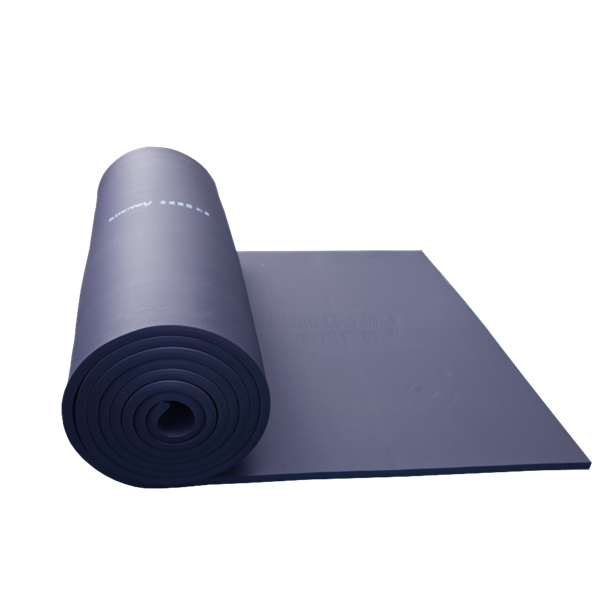
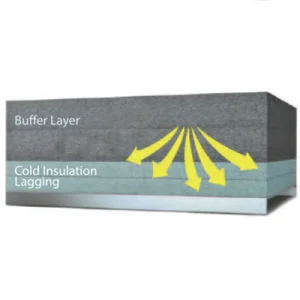
This flexible ultra low temperature insulation system does not need to install an extra moisture-proof layer. Due to its unique closed cell structure and polymer blend formulation, the low temperature elastomeric foam material is highly resistant to water vapor permeation. This foam material provides continuous resistance to moisture penetration throughout the entire thickness of the product.
This flexible ULT insulation system does not require the use of fiber materials as expansion and contraction fillers (typical of rigid foam LNG pipes). On the contrary, it is only necessary to install the low temperature elastomeric material in each layer according to the recommended reserved length to solve the expansion joint problem. The elasticity at low temperatures gives the material the characteristics of expansion and shrinkage in the longitudinal direction.
The system operates reliably in extreme conditions ranging from -200°C up to +110°C, making it ideal for ultra-low temperature and cryogenic applications.
Thanks to its unique closed-cell structure and specialized polymer blend formulation, the material has built-in resistance to water vapor permeation, protecting against moisture throughout its entire thickness without secondary barriers.
No fiber expansion fillers are needed. The material's low-temperature elasticity handles longitudinal expansion and shrinkage naturally when installed according to recommended reserved layer lengths.
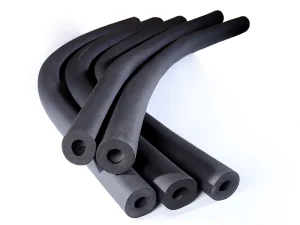
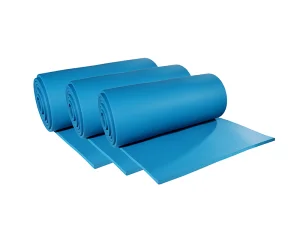
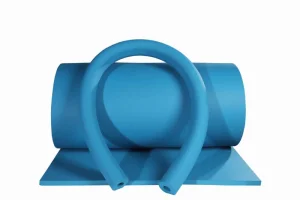
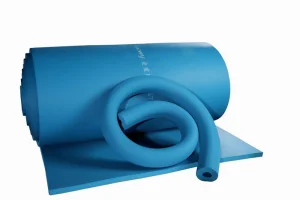
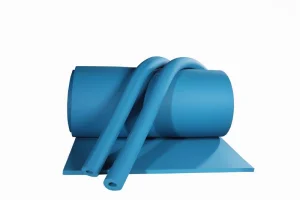
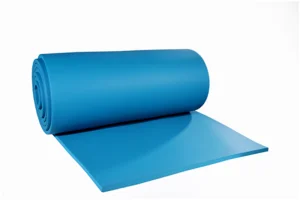
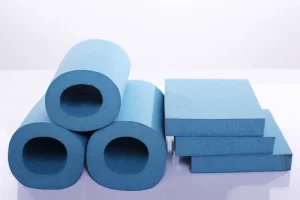
The main materials are ULT (alkadiene polymer in Blue) and LT (NBR/PVC in Black) to suit different technical requirements.
Yes. The material demonstrates high-performance resistance to fungi, ozone, ultraviolet (U.V.) radiation, and harsh weather conditions.
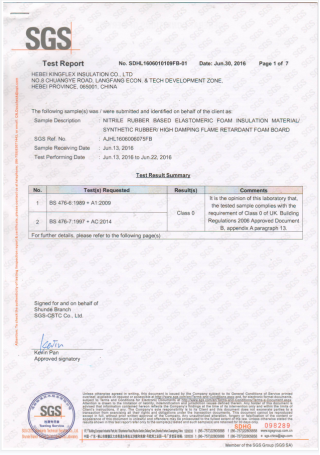
The thermal conductivity remains highly efficient, testing at ≤0.028 W/(m.k) at -100°C and dropping to ≤0.021 W/(m.k) at -165°C.